
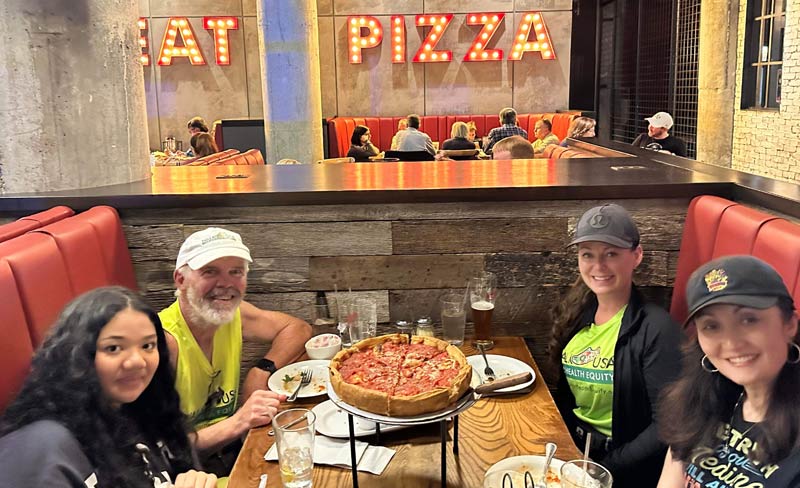

Behind every mile is a network of family, volunteers, and communities whose generosity keeps the walk moving forward.
Sacramento, Calif. – Walking 25 miles a day demands more than determination. It requires preparation, teamwork, and the generosity of people who often receive little recognition. While the miles may belong to the walker, every successful day depends on countless acts of support happening behind the scenes.
Electrolytes are one of those small but essential details. After hours of walking in the heat, water alone isn't always enough. The cooler has to stay stocked, and I have to keep drinking long before I actually feel thirsty. Waiting until my body tells me it's dehydrated is never a good strategy.
The first few days of each new leg of the journey also bring a familiar challenge. Because I'm walking west, the morning sun stays behind me for hours, and the backs of my calves often feel like they're on fire. Thankfully, I've never become sick during any of these walks. I like to think that spending so much time outdoors and soaking up plenty of sunshine—and vitamin D—has played a role.
Walking also changes the way you see the world.
An apple tree beside the road.
A patch of wildflowers.
Fresh fruit discovered after 15 miles somehow tastes better than it ever does at home.
You begin to appreciate simple things that most people speed past without a second thought.
Behind the Scenes of Every Mile
Lunch usually happens wherever my brother David or Tim can safely pull over, preferably with a little shade. But while Rich and I are putting one foot in front of the other, the support person has been anything but idle.
He's locating the next hotel, buying groceries, fueling the vehicle, checking tomorrow's route, doing laundry, refilling the cooler, making sandwiches, and solving problems I haven't even realized exist yet.
Whenever we reach a larger community, we usually stop at Costco or a grocery store to stock up for several more days. Lunch might be sandwiches, fruit, vegetables, chips, water, and electrolytes. After enough miles, even a sandwich assembled in the back of the support vehicle tastes surprisingly close to a gourmet meal.
Almost.
Hospitality That Carries the Walk
One thing many people never see is just how much hospitality has carried this journey.
Across the country, naturopathic doctors, patients, churches, friends, and complete strangers have opened their homes to us. Many evenings have included some of the healthiest meals I've eaten anywhere—fresh vegetables from backyard gardens, homemade soups, colorful salads, fruit, and meals prepared with genuine care.
Yet the food isn't what stays with me the most.
It's the conversations around the table.
A naturopathic doctor might invite patients, neighbors, family members, and friends for dinner. What begins as a shared meal often turns into hours of meaningful discussion about health equity, naturopathic medicine, discrimination in healthcare, and what each of us can do to improve our own communities.
Sometimes one invitation leads to another. A few guests become a dozen. Children wander in from the backyard. Neighbors stop by. Before long, an ordinary dinner has become a community conversation that no one expected.
Looking back, those evenings may have accomplished every bit as much as the miles I walked that day.
Friendships Built One Mile at a Time
Many naturopathic doctors have driven hours out of their way simply to support the walk. Some met me along the route, walked beside me for several hours, welcomed me into their homes for dinner, and then drove me back to the exact spot where we had started so I could continue from that same location the following morning.
That's an extraordinary amount of driving just to help someone else keep walking.
And yet they gladly did it.
One story still makes me smile.
During the North Carolina leg of the walk in 2022, one naturopathic doctor recruited another colleague to join us for a few hours. Four years later, that same doctor—now an ultramarathon runner—is flying all the way to Seattle for the final celebration before returning home almost immediately to compete in another ultramarathon.
You never expect relationships like that to grow from a single afternoon walk.
The miles eventually end.
The friendships don't.
Conversations Along the Road
Every day also brings unexpected encounters with people along the roadside.
Some offer cold bottles of water.
Some stop simply to make sure we're okay.
Others ask where we're headed or why anyone would choose to walk across America.
Those are some of my favorite conversations because they almost always lead to a discussion about health equity.
The larger our walking group becomes, the more curiosity we generate. One person walking down the shoulder of a highway might be overlooked. Two people attract attention. A group wearing matching Walk USA shirts—or even clinical white coats—almost always prompts questions.
Curiosity opens the door to conversation.
And conversations often lead to media coverage, new supporters, and opportunities to spread the message even farther.
Ending the Day—and Preparing for Tomorrow
By the end of most days, Rich and I have covered another 25 miles while David or Tim has somehow kept the entire operation moving forward. We've met people we never expected to meet, solved problems we never anticipated, and shared conversations we'll remember long after the walk is over.
Only then do we begin searching for dinner.
Before eating, though, there's one priority: washing off a full day's worth of sweat. My shower also doubles as laundry day. I simply wash my clothes while showering and hang them up to dry. No washing machine required.
If there's a Mexican restaurant nearby, that's often our first choice. If not, we'll drive until we find somewhere that's still open.
Dinner is more than just another meal.
It's a chance to relive the day's surprises, laugh about the moments that didn't go according to plan, and begin thinking about tomorrow's route.
Later that evening, while many people are winding down, I'm usually writing a Facebook post, responding to patient and walk emails, returning messages, or preparing for the next morning's media interviews.
Then, somewhere around 8:30, exhaustion usually wins.
Tomorrow we'll wake up and do it all again.
Different town.
Different roads.
Different people.
Different surprises.
Learn more at https://walkusaforhealthequity.org/
Stay Tuned for Part 3: Why This Walk Matters (Part 3)
Follow the Series
You Never Really Walk Alone: What It's Really Like Walking Across America (Part 1)