

Updates focus on water system capacity, infrastructure planning, and regional development
Auburn, Calif. – The Placer County Water Agency (PCWA) Board of Directors on Thursday received updates on the Ophir Water Treatment Plant (WTP) program, current system capacity, and regional development activity in West Placer County, highlighting how long-term water planning supports reliability for existing customers while preparing for future needs within adopted conservation and land-use frameworks.
Ophir Program Addresses Capacity Constraints and Improves Reliability
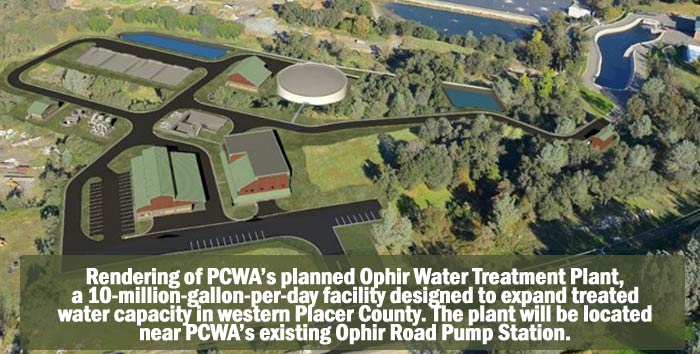
During a workshop presentation, the Board reviewed the Ophir Water Treatment Plant program, a long-planned infrastructure investment needed to provide additional treated water capacity as existing facilities approach their limits to meet peak demand periods.
PCWA staff explained that the Foothill Water Treatment Plant, the agency's largest facility, currently operates near capacity during high-demand summer months, limiting flexibility for maintenance,
upgrades, or unexpected outages. Bringing Ophir online would relieve those constraints by adding a new treated water source and creating system redundancy.
The first phase of the Ophir WTP would provide 10 million gallons per day of new treated water capacity and is designed as part of a phased approach that allows PCWA to scale infrastructure over time. While Ophir is needed to serve future customers, staff emphasized that the project also delivers important benefits for current customers by improving operational flexibility and overall system resilience.
Completion of the Ophir WTP would increase the annual construction window by approximately 2 months to perform essential maintenance and upgrades at the Foothill Water Treatment Plant during lower demand times of the year.
"This is a long-term investment that's been planned for decades," said PCWA General Manager Andy Fecko. "The project is structured so growth pays for growth, with water connection charges funding the capacity needed for new customers. An added benefit is that it also improves reliability and resilience for the customers we already serve."
Cost, Funding, and Project Timeline
The total estimated cost of the Ophir Water Treatment Plant Phase 1 is approximately $234 million, reflecting updated construction and ancillary costs. Funding for the capacity needed to serve new customers comes primarily from Water Connection Charges, which are paid by land developers and future homeowners-not existing ratepayers. The City of Lincoln is a funding partner in the project based on its share of future capacity needs.
PCWA has spent decades planning and preparing for Ophir and has delayed construction as long as possible to reduce borrowing and extend the useful life of existing facilities. Staff noted that current demand projections indicate the facility is needed by 2030 to meet future growth anticipated in the County.
The project is scheduled to go out to bid next month, with construction expected to begin later this year, pending bid results and Board approval. The facility is anticipated to be fully operational and producing treated water in 2030.
Development Update Provided Within Conservation Planning Framework
The Board also received an informational update from Jim Ray, a representative of the development community, on development trends in West Placer County and the Sacramento region.
The update was presented within the context of the Placer County Conservation Program (PCCP), a voter-approved, long-term habitat conservation plan that defines where development may occur while protecting natural resources. PCWA noted that the development discussed reflects growth contemplated under long-adopted General Plans and the PCCP-not new or expanded development areas.
Once development is approved by cities and counties, water agencies plan for safe and reliable service. PCWA's role is to ensure infrastructure is in place to meet those needs while prioritizing conservation, efficiency, and environmental protection.
Long-Term Planning Protects Customers and Resources
PCWA's water system investments are guided by decades of planning and careful financial analysis to balance growth, reliability, and affordability. Agency leaders noted that failing to invest in infrastructure would not only halt growth already planned under local land-use laws, but would increase the risk of service disruptions and result in higher long-term costs.